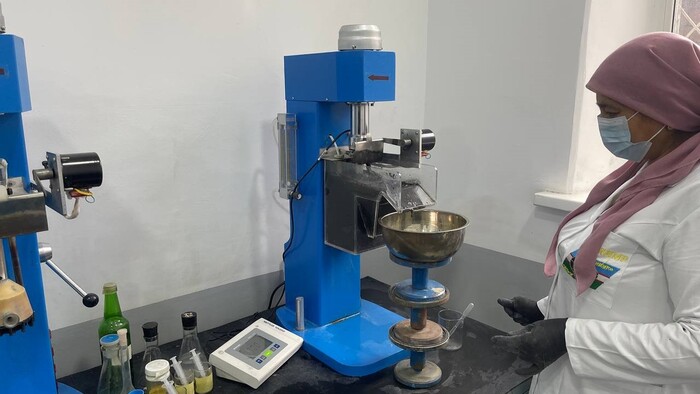
THE MAIN TASKS OF LABORATORY
- study of the material composition of non-metallic minerals;
- study of physical and mechanical properties of rocks;
- comprehensive technological assessment of the quality of non-metallic raw materials;
- laboratory and technological tests of non-metallic raw materials with subsequent assessment of its suitability for the production of various types of products;
- enlarged tests of raw materials with the development of technological regulations for the production of finished products;
- development of new and unconventional technologies for the enrichment and processing of non-metallic raw materials for modern applications;
- development of innovative technologies for obtaining new competitive materials and products from traditional and non-traditional raw materials;
- development of optimal schemes for the enrichment of various types of non-metallic raw materials, taking into account the possibility of complex extraction of both main and associated components.
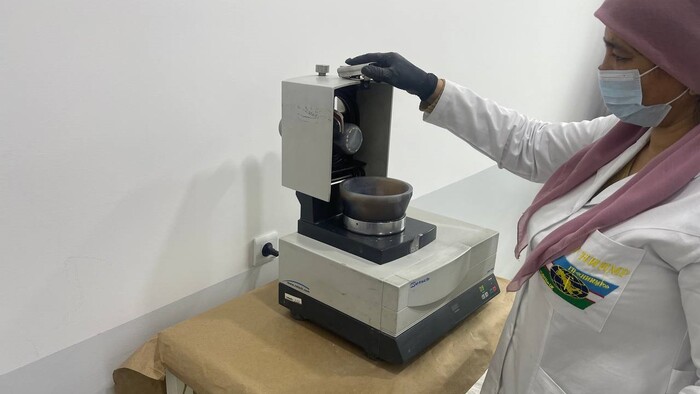
SCIENTIFIC RESEARCH CARRIED OUT IN THE LABORATORY
Development of technologies for obtaining aluminum compounds using biological methods based on the raw material base of the Republic of Uzbekistan;
Development of innovative technologies for the complex processing of non-metallic raw materials (feldspars, quartz, muscovite, sericite, etc.), sufficient to create a profitable production;
Comprehensive study of the material composition of the studied types of non-metallic raw materials (wollastonite, talc, vein quartz), analysis of their quality compliance with modern industry requirements and identification of possible areas of practical application;
Comprehensive study of the material composition of the studied types of non-metallic raw materials (quartz kumi, granite, phosphorite, barite), analysis of their quality compliance with modern industry requirements and identification of possible areas of practical application;
Studying the technological properties of high-magnesium raw materials, developing a cost-effective technology for their processing;
The study of non-traditional types of non-metallic
mineral raw materials with the development of efficient processing technologies;
Development of effective technologies for the extraction of aluminum based on aluminum raw materials from the deposits of Gushsai alunite, Angren and Altyntau kaolins;
Development of technology for obtaining magnesia refractories based on local raw materials;
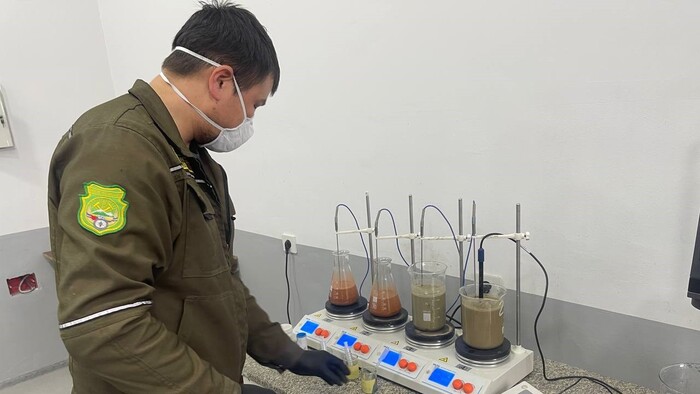
RESULTS OF SCIENTIFIC RESEARCHES
Over the past 5 years, the laboratory has conducted research within the framework of 5 state budget and more than 100 contractual projects.
- As a result of the studies carried out on samples of quartz sand from the Kokayaz manifestation, a technological scheme for deep enrichment of quartz sands was developed to obtain a quartz concentrate with a content of 99,06% quartz, 0,02% iron oxide and less than 0,1% alumina. The resulting concentrate meets the requirements of the industry;
- As a result of laboratory technological studies in a sample of leucocratic granites, manifestations Kattasay-1 obtained feldspar concentrate containing the amount of sodium oxide and potassium 12,15% and iron 0,26%. The resulting product meets the requirements of the relevant standards;
- As a result of laboratory technological studies, phosphate concentrates containing 32,35 and 24,1% P2O5 were obtained in a sample of phosphorites from the Agitma occurrence. The resulting concentrates meet the requirements of industrial requirements;
- When enriching the barite of the Kushkumbay occurrence, a combined concentrate was obtained, which the content of barite reaches 84,6%, with its extraction of 89,6% of the ore. The resulting concentrate meets the requirements of the industry;
- As a result of the enrichment of wollastonite from the occurrence of Beltau, a wollastonite concentrate was obtained with a content of 95,4% wollastonite in it with an extraction of 73,8%. The resulting concentrate can be used for the production of porcelain, ceramics and colored paints;
- As a result of laboratory technological studies in a sample of talc from the Chettik manifestation, a concentrate was obtained containing talc 89,3% and iron 0,96%, with the extraction of talc 67,4%. The resulting talc concentrate meets the requirements of the industry;
- As a result of the enrichment of the vein quartz of the Ermamat manifestation, a quartz concentrate containing 98,9% silicon oxide was obtained using a combined scheme, with its extraction of 78,1%. The concentrate, which contains harmful impurities of iron and aluminum oxides, contains 0,01% and 0,4%, respectively. The resulting concentrate meets the requirements of the glass industry;
- When enriching a sample of serpentinite according to a combined scheme (gravity and electromagnetic separation), a magnesium-containing product was obtained with a content of 49,58% magnesium oxide with its extraction of 72,9%. In order to obtain a product suitable for the production of magnesia refractory material, pyro-hydrometallurgical studies were carried out. As a result of the technological research carried out, a magnesium-containing concentrate with a content of MgO–86,18% and Fe2O3 – 0,1%. The resulting concentrate meets the requirements of the industry;
- The resulting calcined dolomites at temperatures above 900 ° C meet the requirements of the industry and are suitable for use as a raw material for the repair and filling of steel furnaces. In addition, as a result of pyro-hydrometallurgical research, a magnesium-containing product was obtained, with a MgO content of 67.43%, corresponding to the technical characteristics for the production of electrical periclase powders and refractories;
- As a result of the enrichment of the talc sample from the Qizilsoy manifestation according to the recommended combined scheme, a concentrate was obtained containing 90,6% talc with an extraction of talc of 81%. The resulting talc concentrate meets the requirements of industry.