Risk assessment
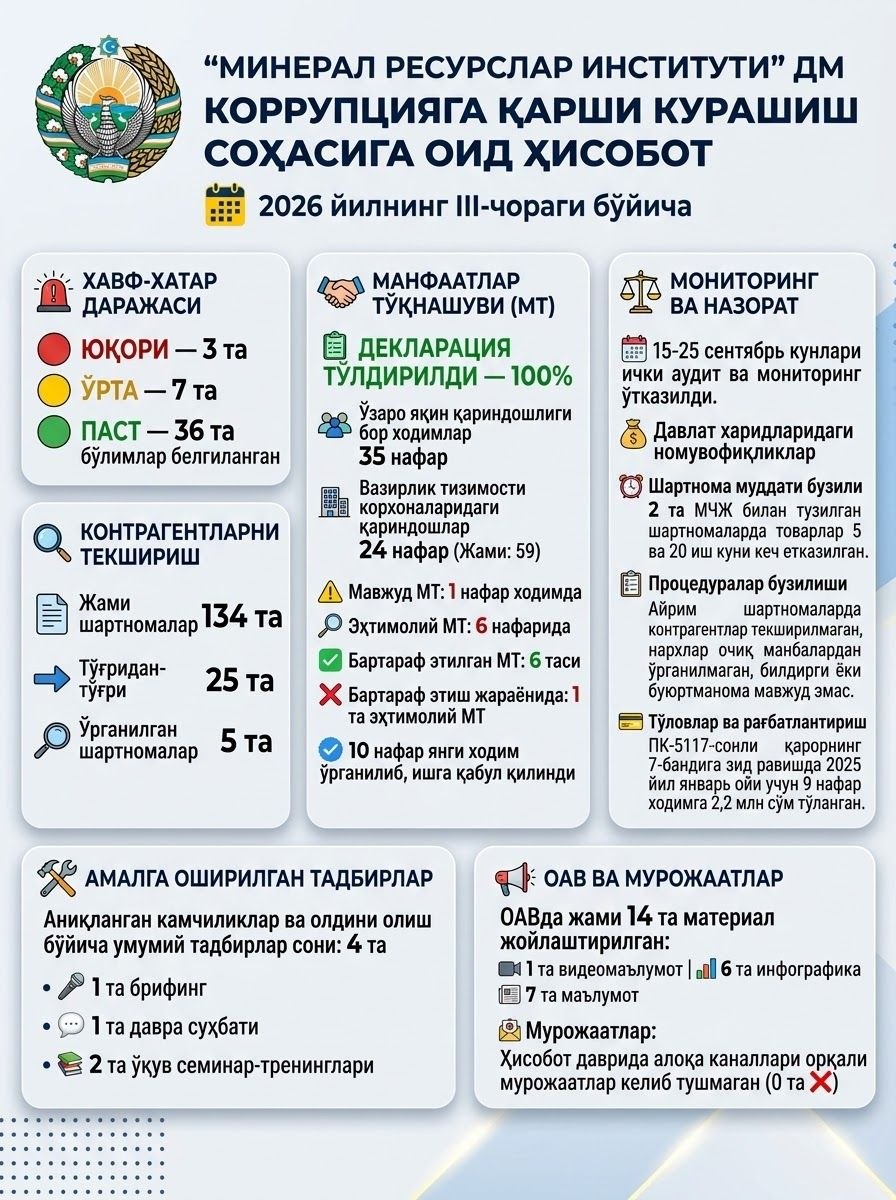
During the reporting period, the MRI department's performance was reviewed, and a re-analysis of the performance of 46 departments was conducted. Of these, 3 were rated as "high" risk, 7 as "medium," and 36 as "low."
To identify, assess and eliminate corruption factors in human resource management activities, monitoring was conducted of departments with a “high” level of corruption risk: the departments of accounting, economics and finance, as well as first-class agents for public procurement, as well as departments with a “medium” level of corruption risk.
The Ministry of Internal Affairs of the Republic of Uzbekistan approved Order No. 117-p dated June 26, 2026, “On approval of the list of positions with a ‘high’ risk of corruption.”
100% of the institute's employees completed a declaration on the presence or absence of a conflict of interest.
Based on employee statements and personal questionnaires, it was established that 35 employees are close relatives of each other, in addition, relatives of 24 employees work at enterprises subordinate to the Ministry of Mining and Geology ( 59 in total ).
The Department of Human Resources Management
published information about vacancies for the third quarter on the Institute's official channels.
Ten new employees were selected and hired . Each was subject to a preliminary interview to ensure no conflicts of interest and was briefed on anti-corruption policies, the Code of Ethics, internal procedures, and methods for preventing negative situations.
This year, a total of 1 employee has already been diagnosed with a muscle injury, 6 potential muscle injuries have been identified and appropriate measures have been taken in accordance with the plan, 6 identified muscle injuries have been eliminated, and 1 potential muscle injury is in the process of being eliminated.
At the same time, in order to combat corruption, the Institute’s Ethics Commission held meetings and issued 12 relevant protocols.
Checking counterparties
A total of 134 contracts were concluded during the reporting period, of which 25 were direct contracts and 5 were renegotiated. The reliability of counterparties was verified, including the absence of any misunderstandings with the institute's employees. To limit the "human factor" in the procurement process and prevent corruption, procurement monitoring was conducted in accordance with the requirements of Law No. ZUR-684 "On Public Procurement."
Monitoring and control
During an anonymous survey conducted in April and May of this year, some respondents noted instances of corruption at the IRI, including unlawful expediting of processes, misuse of funds, favoritism, nepotism, collusion, patronage, compensation payments, and the promotion of personal interests. Based on the anonymous survey data, an internal investigation was conducted to identify possible forms of corruption, but the allegations were not confirmed.
Taking into account the additional risks identified, a “Roadmap for Corruption Risks in MRI Diagnostics” was developed and approved, and planned measures for its implementation will begin on July 1, 2026.
Monitoring of the execution of all payments made by the Institute (for work performed and services rendered, sponsorship expenses and wages, bonuses, gifts, financial assistance to employees and other payments) in accordance with the requirements of regulatory documents has been partially completed.
In accordance with Order No. 122 of the Minister of Mining and Geology of the Republic of Uzbekistan dated September 14, 2026, a working group of the Ministry conducted an internal audit and monitoring at the State Educational Institution "Institute of Mineral Resources" from September 15 to 25. The monitoring revealed that two employees of the Institute of Mineral Resources were 35% founders of an LLC (the employee's employment contract was terminated, and the potential conflict of interest was resolved) and 100% founders of a farm (which is in the process of liquidation).
The following discrepancies were identified during public procurement :
- Some goods were purchased due to production needs, even if they were not included in the annual plan;
- In accordance with the contracts concluded with two LLCs, the delivery of goods was delayed due to internal logistics problems, within 5 and 20 working days;
- In some concluded contracts, no verification of counterparties was carried out, product prices were not studied from open sources of information, and notifications or order forms were missing;
- During the monitoring of payment and incentive processes,
2.2 million monetary sums were paid out.
On October 4, 2026, the “Action Plan for the implementation of the results of monitoring conducted by the Ministry from September 14 to 25, 2026, by the Institute of Mineral Resources in the area of combating corruption” was developed, approved and implemented in accordance with the established procedure.
Forming an intolerant attitude towards corruption by constantly improving the level of knowledge of employees in the field of combating corruption, increasing their legal awareness and culture.
On July 29, 2026, the Compliance Officer provided background information and clarification regarding “the work completed in the first half of 2026 and future priorities in the fight against corruption at the IRI.”
An official appeal from the Director of the Mineral Resources Institute to the team for strengthening anti-corruption measures was published on the institute's official media channels.https://mridm.uz/direktorning-rasmiy-murojati.html).
In total, 4 measures were taken to eliminate the identified deficiencies and prevent corruption in the MRI sector, including: 1 briefing, 1 round table and 2 training seminars for 70 employees based on the Program and Plan.
In total, 14 information materials (1 video, 6 infographics, 7 information materials) related to the area of corruption were published in the official media of the Institute.
During the reporting period, the compliance officer participated in two online seminars on ISO international standards organized by the Management Club and the CERT Academy. He successfully passed the certification exam in his specialty at the Anti-Corruption Agency.
Reports of corruption and violations
No messages were received via communication channels during the reporting period.
Interviews and tests with job candidates were photographed and videotaped and then published in the institute's official media.
Conclusions
Anti-corruption measures at the institute were implemented according to plan, and the state of the anti-corruption system is assessed as satisfactory.
Conflicts of interest are identified in a timely manner, and factors that create the risk of corruption are eliminated at the local level.
It is necessary to accelerate measures to develop an intolerant attitude towards corruption by raising legal awareness and culture among all employees.
Leading Compliance Specialist U. Raupov