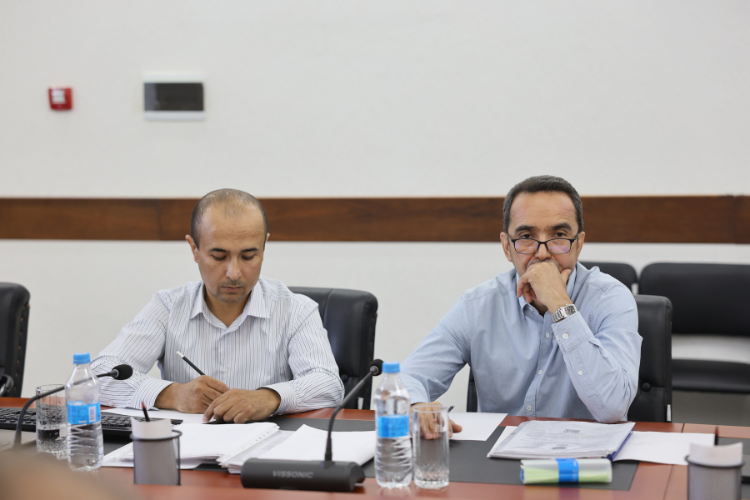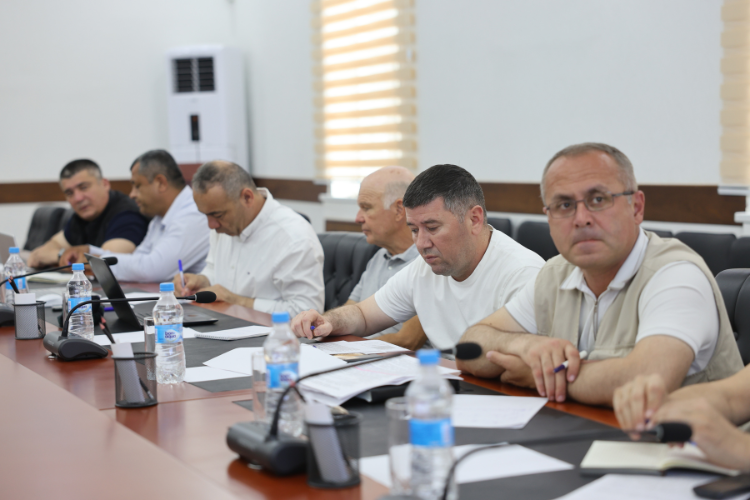
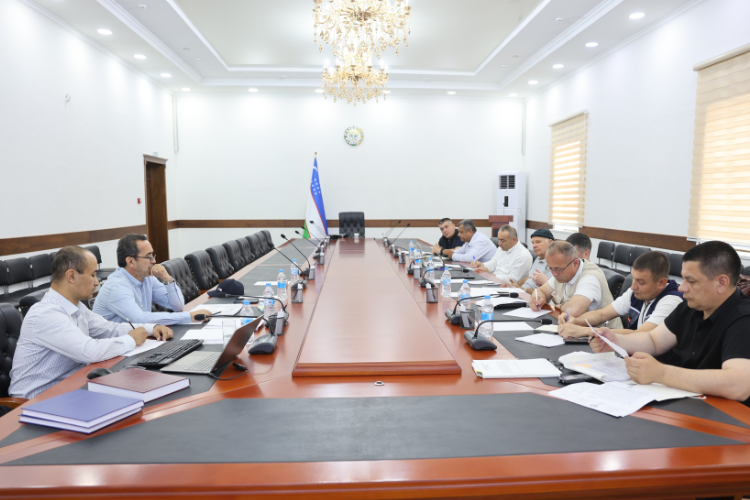
A meeting dedicated to joint projects implemented in cooperation with Navoiyuran and Mineral resurslar instituti was held at the Scientific and Technical Council of “Navoiyuran” DK. The discussion focused on research activities, laboratory results, and large-scale pilot tests aimed at the extraction of uranium, vanadium, copper, rhenium, and rare earth elements.
Responsible specialists from Navoiyuran and Mineral resurslar instituti participated in the meeting. Representing the institute were Director M.U. Isoqov and Head of the Biotechnology and Hydrometallurgy Laboratory R.S. Alimov.
Large-Scale Pilot Tests at the Koscheka and Ma’danli Deposits
One of the key agenda items was the progress of Project No. 5-2025 titled “Large-Scale Pilot Tests on Heap Selective Leaching of Ores from the Ma’danli and Koscheka Deposits.”
As part of the research, large-scale pilot tests on heap selective leaching of ores from the Koscheka and Ma’danli deposits were carried out. Initial agglomerate wetting processes were studied, and it was determined that under an irrigation regime of 5.0 l/(m²·hour), uniform distribution of the leaching solution throughout the heap and a stable filtration regime could be ensured.
In addition, sorption processes using the strong-base anion exchange resin D201U were conducted to recover uranium from productive solutions. During the three-stage cascade process, uranium sorption rates reached 97.5–100% for the Koscheka deposit and 99.2–100% for the Ma’danli deposit.
Potential for Tailings Reprocessing Evaluated
The meeting also reviewed laboratory studies on processing waste materials from the “Gafurovskoye”, “Karta-1–9”, and “Digmayskoye” tailings storage facilities within the framework of Project No. 08-01/1-2026.
The studies tested agitation carbonate-alkaline and sulfuric acid selective leaching methods. According to the results, the carbonate-alkaline selective leaching method was found to be the most suitable for “Gafurovskoye” waste materials, while sulfuric acid selective leaching proved more effective for “Karta-1–9” and “Digmayskoye”.
Based on the recommended technological parameters, uranium recovery rates reached 50.3% for “Gafurovskoye” waste materials, 50.3% for “Karta-1–9”, and 43.4% for “Digmayskoye”. At the same time, it was noted that industrial-scale processing of these waste materials solely for uranium extraction is currently not economically viable.
Research on Black Shale-Type Ores to Continue
The Scientific and Technical Council also discussed the outcomes of Project No. 1-2024 titled “Development of an Integrated Processing Technology for Black Shale-Type Ores from the Ma’danli and Koscheka Deposits with Extraction of Uranium, Vanadium, Copper, and Rhenium.”
Within this research area, international scientific and practical experience in the integrated processing of black shale-type ores was analyzed, the material composition of samples was studied, and laboratory investigations of selective leaching methods aimed at recovering valuable components were conducted.
Following the discussion, it was considered appropriate to continue the recovery of associated metals using industrially representative solutions obtained within Project No. 5-2025.
At the conclusion of the meeting, it was acknowledged that Clause 2.5 of the calendar plan for Project No. 5-2025, “Large-Scale Pilot Tests on Heap Selective Leaching of Ores from the Koscheka and Ma’danli Deposits,” implemented by Mineral resurslar instituti, had been completed in accordance with the technical assignment requirements.